India’s first urban ropeway to launch soon in Kashi: ‘Bhaskar’ witnesses trial; cabins every 2 minutes, ser...
India’s first urban ropeway to launch soon in Kashi:Bhaskar witnesses trial; cabins every 2 minutes, service stops if wind speed exceeds 60 kmph
Anuj Tiwari | Varanasi6 hours ago
The country’s first urban ropeway in Kashi is expected to begin passenger services soon, with 96% of the construction work completed.
The 3.85-km route between Cantt and Godowlia has five stations. The journey from Cantt to Godowlia will take just 16 minutes. At present, covering the same distance of around 7 km by auto takes 30 to 40 minutes.
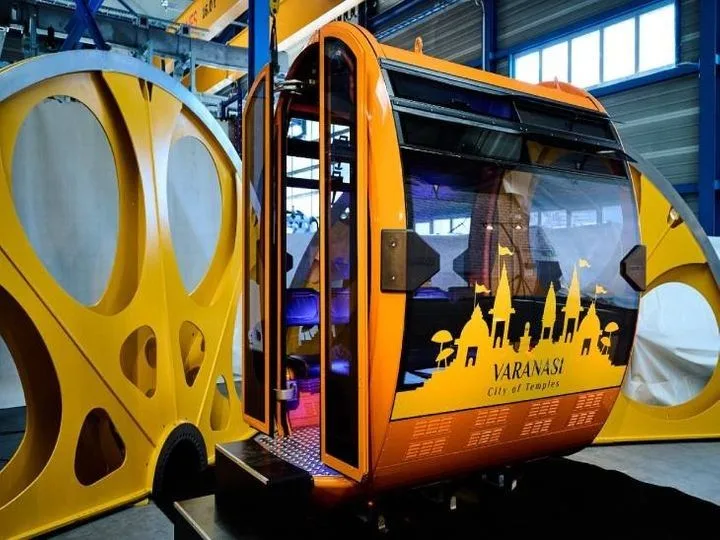
An air-conditioned gondola (cabin) will arrive at a station every two minutes. Each cabin will have seating capacity for 10 passengers. The ropeway is expected to provide major relief from traffic congestion to devotees visiting the Kashi Vishwanath Temple and the ghats along the Ganga.
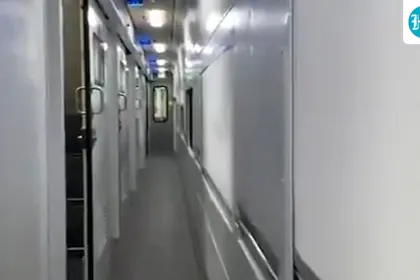
During a trial run, a Dainik Bhaskar reporter travelled on the ropeway and got a close look at its technology, safety arrangements and passenger facilities. Read on…
The ropeway will operate at a height of 45 to 50 metres. One line will carry passengers towards Godowlia, while the other will bring them to Cantt station.
Five stations to offer passengers an aerial view of Kashi
The ropeway will connect five stations: Cantt, Kashi Vidyapeeth, Rath Yatra, Girijaghar and Godowlia. Designed with modern facilities, the stations will also reflect Kashi’s cultural identity.
Their architecture features elements inspired by the Ganga, its ghats and Lord Shiva. Designs incorporating damru and trishul motifs are also being developed.
The ropeway journey will give tourists and local residents an opportunity to enjoy an aerial view of the city.
Full ropeway journey to cost Rs 50, with Rs 10 fare per station
The ropeway will operate for around 16 hours daily, from 6 am to 10 pm. The proposed fares have been set with ordinary commuters in mind. A journey from Cantt to Godowlia will cost Rs 50, while passengers travelling between any two consecutive stations will have to pay Rs 10.
Passengers will be able to get off at any intermediate station according to their requirements. Each gondola will accommodate 10 passengers at a time. A total of 153 gondolas manufactured by Swiss company Bartholet are being installed along the route.
One of the key features of the service is the short waiting time. A gondola will arrive at each station every 120 seconds, or two minutes.
Separate gates have been provided for entry and exit. Passengers will be allowed in only after their tickets are scanned.
Metro-style entry system with baggage screening before boarding
Passengers’ luggage will be screened as soon as they enter the station. They will then have to purchase tickets. Like the Metro, passengers will be allowed to access the platform only after scanning their tickets.
A large hall has been built inside the station where passengers can wait for some time during busy periods. The arrangements have been designed to regulate passenger movement and prevent unnecessary crowding on the platform.
The ropeway station adjoining Cantt railway station has been designed with passenger convenience in mind.
The two-floor Cantt ropeway station will have security checks on the ground floor and ticket counters and a waiting hall on the first floor. Gondolas will arrive on the upper level, from where passengers can board them to travel between stations.
Gondolas to arrive every two minutes for passenger boarding
Gondolas to travel at speeds of 21–22 kmph
The ropeway uses a monocable detachable gondola system, with a maximum operating speed of 6 metres per second, or around 21–22 kmph. When a gondola reaches a station, it detaches from the main cable and slows down to around 0.2 metres per second.
This process takes approximately 45 seconds inside the station, allowing passengers to board and get off comfortably. Once it leaves the station, the gondola reconnects to the main cable and resumes its normal speed.
Backup system to prevent passengers from getting stranded during power cuts
The ropeway is equipped with a backup safety system. If there is a power cut or a fault in the drive system, the backup mechanism will be activated to bring the gondolas to the nearest station. This arrangement is intended to reduce the risk of passengers being stranded mid-route.
Anemometers have been installed on all towers to monitor wind speed. If wind speeds exceed 60 kmph, the system will automatically shut down. The system is also designed to minimise sudden jolts caused by wind while passengers are travelling.
A power backup system has been installed to ensure that the gondolas do not stop in the event of a power failure.
Gondola doors cannot be opened from inside; helpline will connect passengers to control room
Each gondola will have a unique identification number. In case of any problem, passengers will be able to contact the control room directly through a helpline and report the number of the gondola they are travelling in.
The doors will not open from inside, ensuring that passengers do not violate safety protocols during an emergency and allowing the rescue team to carry out operations in a controlled manner.
The ropeway rescue team has received training in Switzerland. A team from the National Disaster Management Authority (NDMA) has also inspected the facility recently.
A team of experts from Switzerland is examining the ropeway’s technical and safety arrangements.
Pooja Mishra, head of the company involved in the ropeway project, said several layers of safety measures had been put in place for passengers.
Each station and gondola is inspected in accordance with separate standard operating procedures (SOPs). A team of experts from Switzerland is reviewing the technical and safety systems, while safety consultants have also been appointed.
Security teams to manage crowds at all five stations
Managing passenger crowds will be a key priority once the ropeway becomes operational. The plan includes deploying State Security Force personnel along with private security staff. The trained operations team will ensure that passengers follow safety rules and movement protocols.
Special attention will be given to entry and exit arrangements, as well as the boarding and alighting of gondolas, at all five stations.
Godowlia station work yet to be completed
More than 96% of the Rs 807-crore project has been completed. Section One is fully ready. In Section Two, the Girijaghar station has been completed, while work on the passenger boarding and exit facilities at Godowlia station is in its final stages. The target is to complete the remaining work within the next few days.
A team of experts from Switzerland is currently conducting technical inspections. Testing of the automation and Supervisory Control and Data Acquisition (SCADA) systems is also pending. An international-level company is carrying out these checks.
Ropeway expected to ease road traffic congestion
At present, travelling from Cantt to Godowlia by road takes around 30 to 40 minutes due to heavy traffic and congestion. Once operational, the ropeway will cover the same distance in just 16 minutes.
The service is expected to provide significant relief to devotees visiting the Kashi Vishwanath Temple, tourists and local residents. It is also likely to reduce pressure on road traffic in the city's busy areas.
Original link: https://www.bhaskarenglish.in/local/uttar-pradesh/varanasi/news/kashi-urban-ropeway-launch
If you are the publisher of this material and would rather it were not here, write to info@banaraslive.com.
Read also
Delhi to Agra in 59 minutes, Lucknow in 2 hours and Varanasi in 3.5 hours: PM Modi approves bullet train
Varanasi Ropeway Project: Second Phase Of Trials Underway, Here's What To Expect
UP Cabinet clears ₹1,947-cr textile park project in Lucknow, Varanasi